

Reputation management strategies differ based on whether an organisation is preventing reputation risk, responding to negative information, or rebuilding search visibility after restructuring.
Online reputation control methods are evaluated through SERP composition, reputation signals, entity credibility, sentiment distribution, and the sustainability of changes across the digital footprint.
Which reputation management approach is most effective during layoffs?
A proactive approach generally provides stronger control because it establishes accurate information before external interpretations dominate search results. Proactive reputation management operates by preparing corporate communications, maintaining consistent entity information, monitoring search results, and establishing authoritative content around organisational changes. Reactive management begins after negative coverage, reviews, or commentary become visible and therefore works within an already developed information environment. The key difference is timing: proactive activity shapes the available information structure, while reactive activity addresses an existing reputation condition. Both approaches require search visibility analysis to determine whether the available information accurately represents the organisation.
The effectiveness of either approach depends on the reputation problem being addressed. A planned restructuring announcement requires a different information strategy from a sudden wave of negative employee reviews. Proactive communication provides factual context, while reactive analysis identifies information gaps, inconsistencies, or high-visibility negative results. The strongest evaluation therefore considers the source, visibility, authority, and relevance of each reputation signal. This prevents organisations from applying content enhancement to a problem that requires source-level correction or removal.
How does content creation compare with content removal during restructuring?
Content creation and content removal operate at different levels of the reputation ecosystem. Content creation strengthens the information environment by publishing relevant, accurate, and authoritative material that search engines can index. Content removal addresses qualifying information at its original source and therefore targets information availability rather than search prominence. Creation offers greater control over the organisation’s own informational assets, while removal depends on the nature of the content and the policies or legal mechanisms governing the source. Their effectiveness therefore depends on whether the underlying problem concerns insufficient information or inappropriate existing information.
Content enhancement also provides a longer-term mechanism because high-quality pages can support multiple relevant search queries. Removal produces a more direct outcome when information qualifies for deletion, but removing one source does not automatically eliminate references elsewhere. Copies, syndicated articles, reviews, or independent discussions can remain part of the digital footprint. Content creation therefore has broader scalability, while removal provides greater precision for specific eligible information. A complete evaluation examines both source-level control and search-level visibility.
Is proactive reputation management stronger than reactive reputation repair?
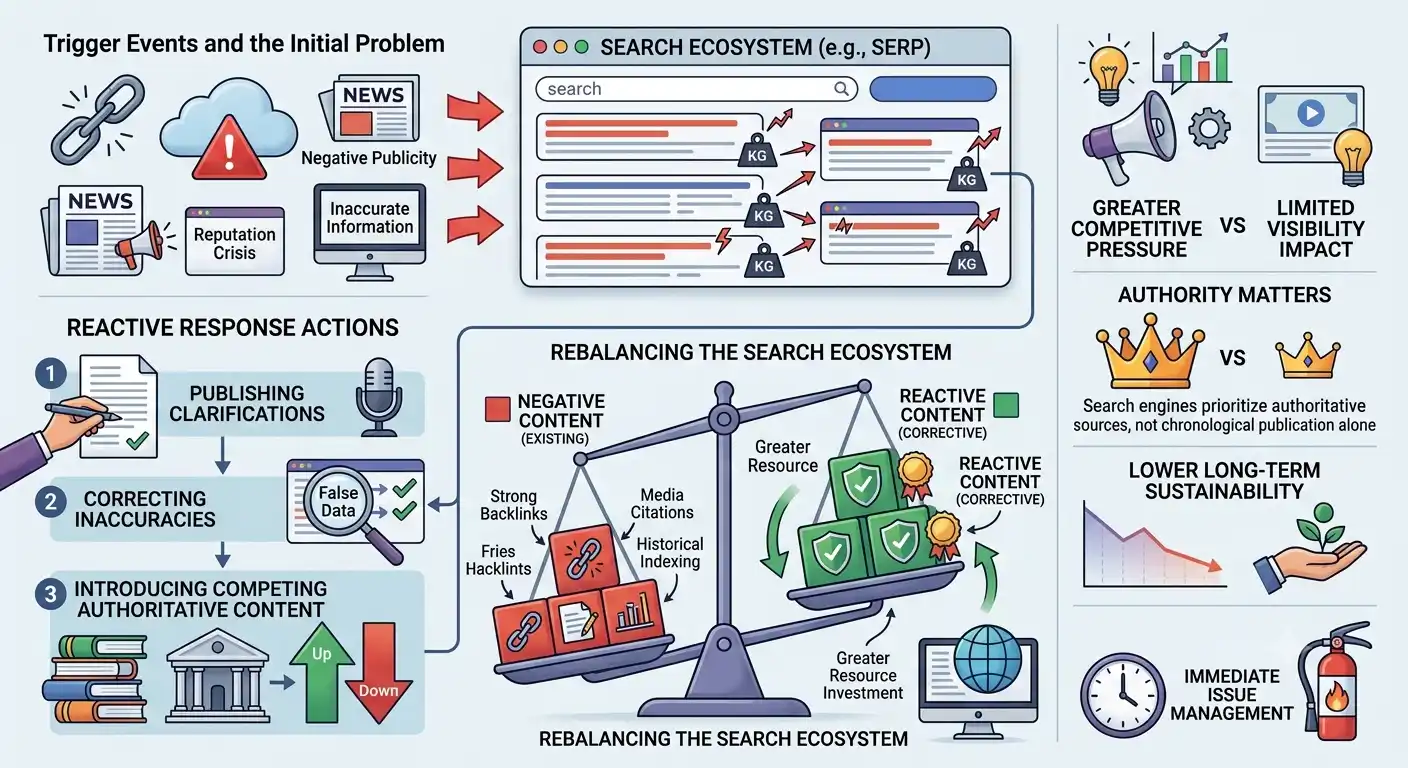
Proactive reputation management is stronger for prevention because it establishes a coherent information structure before a reputation issue becomes dominant. It operates through prepared communication, accurate corporate information, consistent employer profiles, relevant content, and continuous monitoring. Reactive reputation repair begins when a visible problem already exists and therefore concentrates resources on correcting an established perception. The proactive model reduces information gaps, while the reactive model focuses on identifiable reputation damage. The difference is particularly important during restructuring because search results can change rapidly as news and commentary are published.
Reactive management nevertheless provides greater specificity when a particular result or reputation signal requires intervention. It can identify which pages rank for branded queries, which reviews contain recurring themes, and which external sources influence entity perception. Proactive activity cannot remove the need for this analysis because search ecosystems continuously change. The most sustainable framework therefore combines prevention with structured response. This creates a reputation system that addresses both emerging risks and existing visibility problems.
How do short-term and long-term reputation tactics compare?
Short-term reputation tactics focus on immediate visibility problems, while long-term tactics strengthen the wider digital information structure. A short-term intervention can address a highly visible negative result, an inaccurate profile, or a sudden increase in negative review sentiment. Long-term reputation work develops authoritative content, consistent entity information, credible external references, and ongoing monitoring. The first approach prioritises speed and issue resolution, while the second prioritises sustainability and resilience. Comparing them solely through immediate ranking movement therefore produces an incomplete assessment.
Long-term impact depends on whether the reputation strategy continues generating useful signals after the initial intervention. Search engines continuously reassess indexed information, meaning temporary ranking changes do not guarantee persistent SERP composition. A durable content structure provides multiple relevant sources that support entity credibility across different queries. Short-term interventions remain valuable when a specific risk requires immediate attention. The strongest strategy therefore measures immediate visibility changes alongside longer-term improvements in information quality and entity consistency.
How does content suppression compare with content enhancement?
Content suppression focuses on reducing the prominence of specific negative results, while content enhancement strengthens relevant information that competes within the same search environment. Suppression operates through changes in relative SERP visibility rather than deletion of the underlying page. Enhancement operates by improving the quality, relevance, authority, and search competitiveness of alternative content. These mechanisms produce different risk profiles and measurement requirements. Suppression is more targeted, while enhancement generally provides a broader foundation.
The distinction becomes important when restructuring-related coverage remains highly visible. If a negative article is legitimate and cannot be removed, suppression focuses on the surrounding SERP rather than attempting to eliminate the source. Enhancement can introduce stronger authoritative information that provides users with additional context. However, publishing content without analysing search intent and ranking competition provides limited search ranking influence. Effective evaluation therefore considers content quality, authority, indexing, query alignment, and the prominence of competing results.
How do search engines interpret employer reputation signals?

Search engines interpret employer reputation through relationships between entities, documents, queries, sources, and user-generated information rather than through one universal reputation score. An employer entity becomes associated with content covering layoffs, restructuring, workplace conditions, reviews, corporate announcements, and external reporting. Ranking systems then evaluate which information is relevant and authoritative for individual queries. This produces different SERP compositions depending on search intent and content competition. Reputation signals therefore influence perception indirectly through the information users encounter.
Entity credibility develops through consistency across multiple sources. Corporate websites, professional profiles, employment platforms, news publishers, review sites, and industry references each contribute contextual information about the organisation. Consistent information makes the entity easier to identify and understand, while conflicting information introduces additional ambiguity. Search engines evaluate these relationships alongside content quality and relevance. Reputation management therefore requires analysis of the complete entity environment rather than one isolated page.
Which reputation signals matter most after layoffs?
The most relevant signals after layoffs include news coverage, employee reviews, corporate communications, professional profiles, search visibility, and authoritative third-party references. Each signal contributes a different form of information to the employer’s digital footprint. News coverage provides external reporting, reviews provide user-generated sentiment, and corporate content provides the organisation’s own factual context. Search visibility determines which of these sources users encounter first. Their combined presence influences entity perception more than any individual signal in isolation.
Sentiment distribution is particularly relevant when employee reviews and social commentary increase after restructuring. Sentiment distribution refers to the balance of positive, negative, and neutral themes within user-generated information. It provides contextual evidence about recurring perceptions but does not operate as a standalone ranking factor. Review content must therefore be evaluated alongside source authority, relevance, volume, and search visibility. This produces a more accurate understanding of how employee sentiment contributes to employer reputation.
Dive Deeper With Our Expert Guides:
How to Build B2B Trust Signals That Shorten the Sales Cycle
Communicating a Data Breach Without Destroying Customer Trust
How should organisations evaluate reputation strategies by risk?
Reputation strategies are best evaluated through effectiveness, risk exposure, scalability, control, and sustainability. Effectiveness measures whether the tactic addresses the identified reputation condition, while risk exposure considers compliance, platform policies, factual accuracy, and potential credibility consequences. Scalability examines whether the method remains practical as the organisation’s digital footprint expands. Sustainability measures whether the outcome continues after active intervention decreases. These criteria provide a more reliable framework than measuring success through rankings alone.
A structured evaluation process can separate each strategic decision:
- Identify the reputation issue by distinguishing negative coverage, inaccurate information, review sentiment, weak authority, and limited search visibility.
- Compare intervention mechanisms by assessing whether removal, suppression, enhancement, or monitoring directly addresses the identified issue.
- Measure SERP composition by tracking which pages rank for branded, employment, restructuring, and reputation-related queries.
- Assess sustainability by determining whether the strategy creates durable information assets or depends on repeated short-term intervention.
This framework reduces the risk of selecting a tactic based solely on its apparent speed. A fast ranking change has limited strategic value if the underlying information environment remains weak or inconsistent. Conversely, a slower content strategy can provide greater long-term value when it establishes authoritative information across multiple relevant queries. Evaluation therefore needs to connect the mechanism with the intended outcome.
How does employer communication affect reputation during restructuring?
Employer communication provides an authoritative information source that establishes factual context around organisational change. Official announcements, corporate newsroom pages, investor communications, and recruitment information can become indexed and appear in relevant search results. These assets provide search engines with structured information about the organisation, its activities, and the circumstances surrounding restructuring. Consistent communication therefore strengthens the entity’s informational foundation. It does not determine how external publishers or employees interpret the event.
The main advantage of controlled communication is factual consistency. Consistent terminology across corporate pages reduces ambiguity and gives users a stable reference when comparing external information. Inconsistent statements create additional information relationships that can complicate entity interpretation. Corporate communication therefore functions as one reputation signal within a broader ecosystem. Its effectiveness depends on how well it connects with external information, search intent, and the wider digital footprint.
Which strategy provides greater scalability for employer reputation?
Content enhancement generally provides greater scalability because one authoritative information asset can support multiple relevant queries and strengthen several entity relationships. A comprehensive restructuring resource, for example, can address organisational updates, employment information, corporate context, and related search intent within one structured content ecosystem. Removal is less scalable because each source requires separate assessment and an appropriate removal mechanism. Suppression also requires continuous monitoring because ranking competition changes over time. Scalability therefore depends on whether the tactic creates reusable reputation assets.
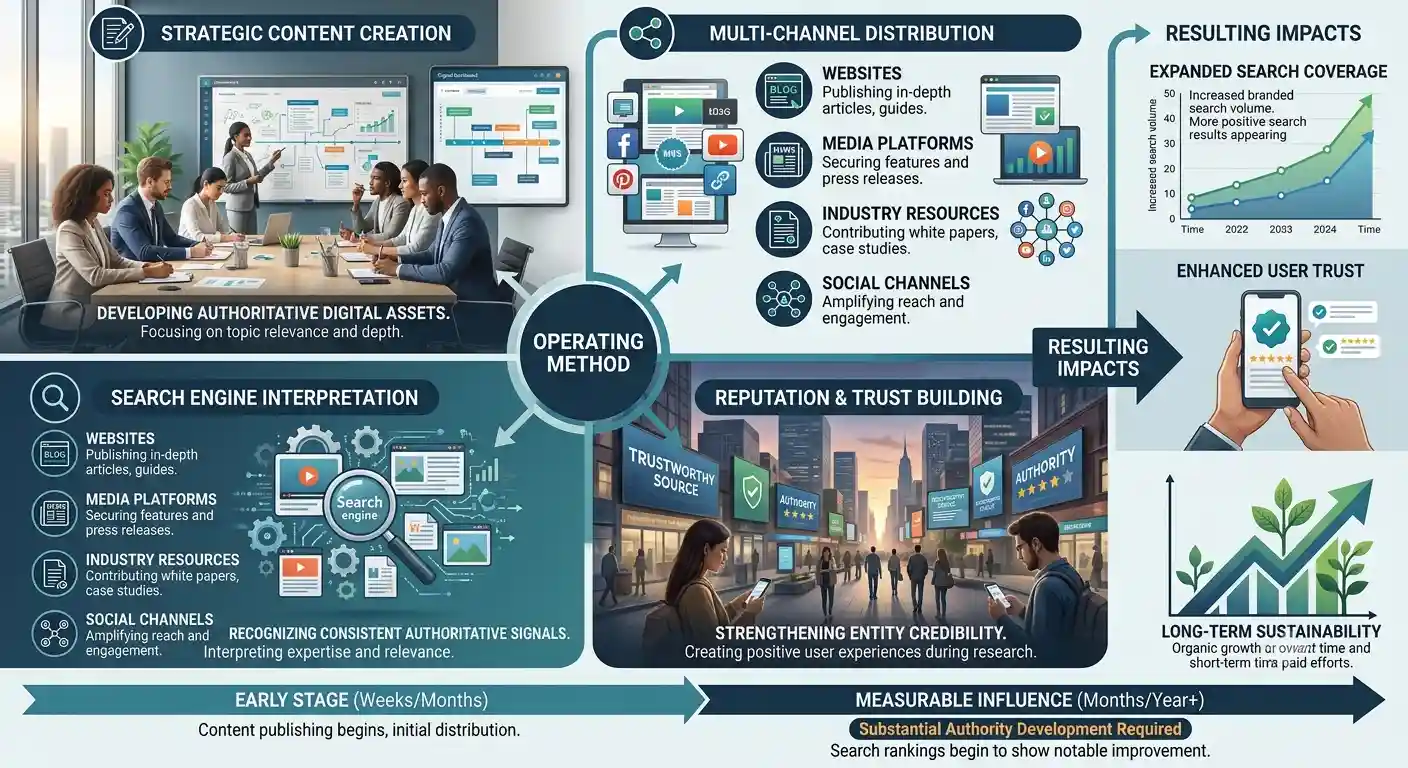
Organic reputation development also distributes risk across multiple information sources. If the digital footprint contains accurate corporate content, credible external references, relevant professional information, and legitimate review signals, one negative result has less influence over the complete information environment. This does not eliminate negative coverage or guarantee a particular ranking position. Instead, it creates a broader set of signals through which users and search systems interpret the entity. Sustainable scalability therefore comes from information diversity and consistency.
How can organisations balance reputation control with search transparency?
Reputation control is most sustainable when it improves information accuracy and relevance rather than attempting to conceal legitimate public information. Search transparency requires distinguishing between correcting inaccurate material, removing eligible information, and reducing the prominence of legitimate negative coverage through stronger competing information. These mechanisms have different ethical and operational implications. Accurate information provides a stronger basis for entity credibility than artificial attempts to manipulate search results. The objective is therefore a more coherent information environment rather than the elimination of every negative reference.
This distinction also reduces risk exposure during restructuring. Legitimate news reports and employee opinions form part of the public information ecosystem and cannot simply be treated as incorrect because they are unfavourable. A responsible strategy analyses source quality, factual accuracy, relevance, and search prominence before selecting an intervention. Content enhancement then provides additional authoritative context without altering the underlying facts. This creates a clearer relationship between reputation management and trustworthy search perception.
What makes an employer reputation strategy sustainable after layoffs?
A sustainable employer reputation strategy combines accurate communication, authoritative content, review monitoring, search analysis, entity consistency, and ongoing evaluation. Each component addresses a different part of the digital reputation system. Communication provides factual context, content enhancement strengthens searchable information, reviews reveal user-generated sentiment, and monitoring identifies changes in SERP composition. Together, these mechanisms create a broader reputation infrastructure. Sustainability comes from maintaining this infrastructure rather than relying on a single intervention.
The long-term objective is not to erase the historical record of restructuring. It is to ensure that the organisation’s searchable identity remains accurate, relevant, and sufficiently contextualised as new information develops. Search engines continuously process new pages, references, reviews, and queries, so employer reputation remains dynamic. A sustainable strategy therefore monitors both new reputation signals and changes in existing content visibility. This approach provides greater resilience against sudden shifts in search perception.
How should businesses choose between reputation management approaches?
Businesses should choose reputation management approaches according to the source, visibility, severity, and persistence of the reputation issue. Content creation is appropriate for strengthening information depth, removal addresses eligible source-level problems, suppression targets search prominence, and monitoring identifies emerging changes. Proactive methods focus on prevention, while reactive methods address established issues. Short-term tactics prioritise immediate visibility, while long-term methods strengthen the broader information ecosystem. Each mechanism therefore has a distinct strategic role.
A decision framework also needs to account for risk and sustainability. Organisations can compare the expected search visibility impact against implementation complexity, external dependencies, scalability, and the durability of the outcome. This prevents a single tactic from being treated as a universal reputation solution. The best approach is the one that directly corresponds with the information condition identified through search and reputation analysis. This creates a more evidence-based path towards managing employer reputation during organisational change.
What is the most sustainable approach to protecting employer reputation through layoffs?
The most sustainable approach combines proactive communication, authoritative content development, reputation monitoring, review analysis, and targeted responses to high-visibility negative information. This model addresses both the information created during restructuring and the way that information becomes visible in search results. It balances content enhancement with appropriate source-level interventions rather than depending entirely on suppression or removal. The result is a broader digital footprint with clearer entity relationships and stronger contextual information.
Protecting employer reputation is therefore a systems-level process rather than a single SEO tactic. Organisations need to evaluate how news, reviews, corporate statements, social references, and authoritative content interact within the SERPs. Protect employer reputation through layoffs provides a focused framework for evaluating how these mechanisms can be integrated when restructuring creates heightened search visibility and reputation risk. The central consideration remains the relationship between information accuracy, search prominence, entity credibility, risk exposure, and long-term sustainability.
How can a company protect its reputation during layoffs?
Companies can protect employer reputation through clear communication, accurate corporate information, employee review monitoring, and consistent search visibility management. These measures create reliable reputation signals and provide context around organisational restructuring.
How do layoffs affect an employer’s online reputation?
Layoffs can generate news coverage, employee reviews, social discussions, and other indexed content that becomes part of an organisation’s digital footprint. The visibility and authority of these sources influence employer perception in search results.
What is the difference between proactive and reactive reputation management during layoffs?
Proactive reputation management establishes accurate information and monitors reputation signals before significant issues develop. Reactive reputation management responds to existing negative content, reviews, or search visibility problems after they become identifiable.
Can content suppression help protect an employer’s reputation after layoffs?
Content suppression focuses on reducing the prominence of specific negative results within search engine results pages rather than removing the underlying content. It works by strengthening relevant, authoritative information that competes within the same search environment.
What reputation signals matter most after company restructuring?
Key reputation signals include news coverage, employee reviews, corporate communications, social references, professional profiles, and authoritative third-party content. Their relevance, sentiment, authority, and search visibility contribute to overall employer entity perception.