

Strong distributor and wholesale reviews improve the reputation signals retail buyers use when assessing supplier credibility, while controlled search visibility ensures credible information receives appropriate attention. A structured reputation management process strengthens review quality, reduces reputation risk and improves the information environment surrounding a wholesale or distribution business.
For B2B suppliers, reputation extends beyond star ratings. Retail buyers assess fulfilment reliability, product consistency, communication, delivery performance and commercial credibility through reviews, search results, business profiles and third-party references. When negative or inconsistent information becomes prominent, the issue becomes a search perception problem as well as a review management problem.
Which Reputation Management Approach Delivers Measurable Results?
A structured reputation management approach delivers measurable results by combining review analysis, reputation signal development, search visibility monitoring and appropriate content management. The objective is not simply to increase the number of positive reviews; it is to improve the quality and balance of information that retail buyers encounter when researching a supplier. This distinction makes the strategy more reliable than isolated review responses.
The process begins with a reputation audit that identifies review sources, sentiment patterns, prominent search results and competing credibility signals. Each source is assessed according to relevance, visibility, authority and potential impact on buyer perception. This establishes a measurable baseline before any reputation activity begins.
A professional reputation management service then connects individual review activity with the wider digital footprint. Professional reputation management for businesses provides a structured framework for analysing customer feedback, strengthening credible information and monitoring changes in search perception. The result is greater control over the information environment rather than dependence on one platform or one type of reputation signal.
How Does Review Management Strengthen Distributor Credibility?
Review management strengthens distributor credibility by improving the quality, relevance and consistency of third-party reputation signals. Retail buyers need evidence that a supplier performs reliably across areas such as fulfilment, product quality, delivery and communication. Detailed customer feedback provides this evidence in a format that can be evaluated alongside business-controlled information.
A structured review strategy analyses recurring themes rather than treating every review as an isolated event. Repeated references to accurate orders, dependable delivery or responsive communication create identifiable reputation patterns. Recurring negative themes receive the same analytical treatment because they can reveal operational concerns or create disproportionate visibility within the digital footprint.
The process also distinguishes legitimate criticism from content that qualifies for an appropriate platform review or removal mechanism. This protects credibility because the objective remains accurate information management rather than artificial reputation manipulation. Where content violates applicable platform rules, the relevant evidence and reporting mechanism provide a defined route for assessment.
This approach creates stronger entity credibility because review information becomes part of a broader and more coherent representation of the distributor. The business is evaluated through multiple reputation signals rather than one isolated rating.
How Does Search Visibility Control Improve B2B Reputation?
Search visibility control improves B2B reputation by influencing which credible and relevant information receives attention during supplier research. Search engines determine rankings through complex systems involving relevance, authority, content quality and other signals. Reputation management does not guarantee a specific ranking position; it improves the strategic balance of information competing for visibility.
Branded searches are particularly important because they often represent a point where a potential buyer actively investigates the supplier. A search result containing authoritative business information and relevant positive reviews creates a different perception from one dominated by unresolved negative content. The composition of the SERP therefore becomes a measurable reputation indicator.
Search perception influence operates through legitimate optimisation rather than manipulation. Relevant content is strengthened, authoritative information is developed and harmful content is assessed according to its source, accuracy and visibility. Over time, this can improve the information balance surrounding the entity.
Clear My Name uses this type of structured analysis to connect review reputation with broader search visibility. The emphasis remains on evidence-based reputation signals, measurable SERP changes and a coherent digital footprint rather than unsupported ranking promises.
When Does Negative Content Suppression Deliver Greater Value?
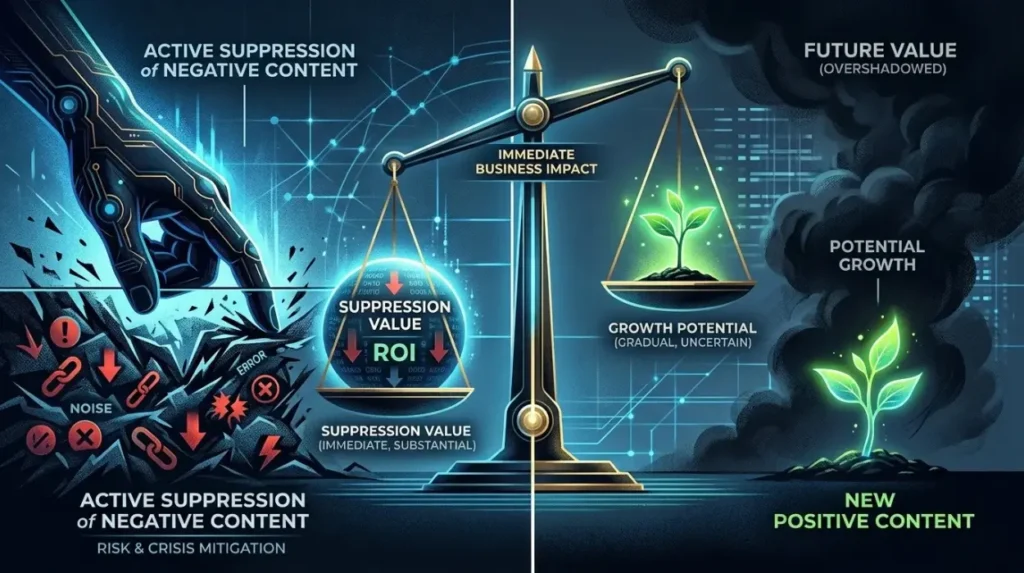
Negative content suppression delivers greater value when harmful or inaccurate information occupies disproportionate search visibility compared with credible information. Suppression is not the same as deleting criticism; it involves reducing the prominence of damaging content through legitimate search optimisation, authoritative content development and applicable removal processes.
For distributor and wholesale businesses, negative information can relate directly to commercial reliability. Complaints concerning delayed fulfilment, product quality or communication can influence a retail buyer’s perception when these pages appear prominently for branded searches. The visibility of the information therefore matters alongside the underlying sentiment.
A professional strategy first determines why the content is visible. Factors such as relevance, authority, indexing, content depth and external references help explain its search position. This analysis determines whether the appropriate response involves content assessment, legitimate removal, content enhancement or broader SERP control.
Negative content suppression can therefore support risk reduction without relying on unrealistic promises. Its effectiveness is measured through changes in content prominence, search-result composition and the relative visibility of credible reputation signals.
Is Content Enhancement More Sustainable Than Reactive Review Handling?
Content enhancement provides greater long-term sustainability because it strengthens the information environment instead of relying exclusively on responses to individual reputation events. Reactive review handling remains useful for addressing specific feedback, but it does not automatically improve the wider digital footprint. A sustainable strategy therefore combines immediate reputation control with ongoing credibility development.
Content enhancement operates by creating or improving authoritative information that accurately represents the business. This can include detailed service information, company expertise, operational information and other relevant content that provides search engines and buyers with stronger contextual signals.
Reactive handling operates differently. A business responds to an individual review, assesses potentially problematic content or uses a platform’s reporting process where applicable. This produces targeted action but remains limited to the specific content being addressed.
The two approaches therefore serve different functions. Reactive activity reduces immediate reputation risk, while content enhancement builds a stronger long-term information environment. Combining both produces greater resilience because new negative content does not become the sole focus of the strategy.
Dive Deeper With Our Expert Guides:
Manage Acquisition and Merger Speculation With Clear My Name
Manage Acquisition and Merger Speculation With Clear My Name
How Can Reputation Management Improve Search Results for Wholesale Businesses?
Reputation management improves search results by strengthening the relevance, authority and visibility of credible information associated with the business entity. Search engines index and evaluate content independently, so reputation management does not directly control their algorithms. Its role is to improve the information ecosystem that search engines and users encounter.
A structured process begins by identifying the search queries that matter commercially. Branded searches, supplier-related searches and reputation-focused queries reveal which pages currently dominate the SERP. This establishes where negative content creates visibility risk and where credible content has an opportunity to provide stronger context.
The next stage involves improving the underlying information architecture. Relevant authoritative pages are strengthened, inconsistent business information is identified and reputation sources are assessed for quality and relevance. These actions support a more coherent entity representation.
The resulting outcome is measured through SERP composition rather than promises of a specific position. Effective reputation management tracks whether credible pages gain visibility, whether harmful content loses prominence and whether the overall information environment becomes more balanced.
What Outcomes Can Businesses Measure From Review Reputation Management?
Businesses can measure review reputation management through changes in review sentiment, content visibility, search-result composition and entity credibility. These measurements provide stronger evidence than simply counting the number of new reviews. The critical question is whether reputation signals are becoming more useful and visible to the audiences making commercial decisions.
A structured programme can:
- Measure sentiment distribution by tracking changes in positive, neutral and negative review patterns over defined periods.
- Monitor SERP composition by recording the visibility of review pages, business profiles and authoritative content for branded searches.
- Assess content prominence by identifying whether harmful pages remain highly visible or lose search exposure.
- Evaluate entity credibility by checking consistency across websites, review platforms, directories and third-party references.
- Track reputation trends by comparing current signals with established baseline measurements.
These metrics also create process accountability. Each action can be connected to a specific reputation problem and evaluated against an identifiable outcome. This makes the service easier to assess from a cost, risk and performance perspective.
How Quickly Can Reputation Management Influence Search Perception?
Reputation management produces different outcomes at different stages because review activity, content indexing and search ranking operate on separate timelines. Strengthening Distributor and Wholesale Reviews requires recognising these different timelines and measuring progress accordingly. Platform-level changes can become visible relatively quickly, while search visibility changes depend on discovery, indexing and ranking processes. A reliable strategy therefore measures progress across multiple timeframes rather than using one fixed expectation.
Immediate actions focus on existing reputation risks. Review analysis, content classification and appropriate platform reporting establish control over the identified problem. These activities create a clear operational foundation before longer-term search optimisation begins.
Medium-term activity focuses on strengthening credible reputation signals and improving relevant content. Search engines need to discover, process and evaluate those changes before their visibility changes. Monitoring these stages prevents premature conclusions about effectiveness.
Long-term impact depends on sustainability. A stable reputation environment requires continued monitoring because new reviews, publications and search results constantly change the digital footprint. Ongoing measurement therefore provides stronger risk control than a one-off reputation intervention.
Does Reputation Management Deliver Long-Term Value for Distributors?
Reputation management delivers long-term value when it reduces exposure to reputation risk while strengthening the information buyers use to evaluate the business. The commercial value comes from improving trust signals at the research stage, where visible reputation information can influence supplier consideration. This makes reputation management an investment in information quality and search perception rather than simply review administration.
Cost evaluation becomes clearer when the strategy is linked to measurable reputation outcomes. Businesses can assess the visibility of negative content, the quality of positive reputation signals and the strength of their search-result composition. These measurements provide a basis for comparing reputation investment against the risk associated with uncontrolled information.
Sustainability also reduces operational inefficiency. A defined monitoring process identifies emerging problems before they become established search visibility issues. This reduces dependence on repeated emergency responses and creates a more predictable reputation management framework.
For businesses with significant B2B search exposure, the long-term objective is reputation stability. Stronger credibility signals, diversified information sources and consistent monitoring create a digital environment that remains resilient as new content appears.
How Does a Structured Reputation Process Reduce Risk?
A structured reputation process reduces risk by separating diagnosis, action and measurement. This prevents businesses from applying the same response to every negative review or search result. Each reputation issue is assessed according to its source, relevance, visibility, accuracy and potential effect on buyer perception.
The process can:
- Audit review profiles and search results to establish the current reputation baseline.
- Classify content according to sentiment, accuracy, relevance and applicable platform policies.
- Prioritise reputation risks according to visibility and potential influence on commercial decision-making.
- Strengthen credible information through relevant content and legitimate reputation signal development.
- Monitor SERP changes and sentiment distribution to measure the impact of implemented actions.
This structure improves reliability because every stage has a defined purpose. It also creates evidence for future decisions by recording which reputation signals changed and how their visibility evolved.
For distributors and wholesalers, this is particularly important because reputation information often extends across multiple digital environments. A Facebook review, business directory, independent review platform and search result can each contribute to the same entity perception. Addressing them as connected reputation signals provides stronger control than treating each platform independently.
Is a Professional Reputation Management Service Worth the Investment?
A professional reputation management service delivers greater strategic value when reputation problems extend beyond isolated reviews and affect search visibility, entity credibility or buyer trust. The service combines specialist analysis with a defined process for monitoring, content assessment, search perception and reputation signal development. This creates a more comprehensive solution than handling reviews individually.
The value becomes clearer when reputation risk is persistent. A business dealing with recurring negative reviews, prominent damaging pages or inconsistent digital information requires continuous analysis rather than occasional intervention. Professional oversight provides the infrastructure required to identify changes, prioritise risks and maintain consistent execution.
The strongest service model also provides process transparency. Businesses need to understand what is being analysed, which actions are appropriate, how progress is measured and which outcomes are realistic. Clear methodology strengthens trust because reputation activity remains connected to evidence rather than vague promises.
Clear My Name positions its reputation management process around this combination of analysis, execution and measurement. The focus is on strengthening credible reputation signals, improving search visibility control and reducing the exposure created by damaging or inconsistent information.
How Can Businesses Strengthen Distributor Reviews With Greater Confidence?
Businesses can strengthen distributor reviews with greater confidence by combining legitimate customer feedback development with search perception analysis and ongoing reputation monitoring. The process begins with understanding what retail buyers actually evaluate, including reliability, product quality, fulfilment and communication. These priorities determine which reputation signals deserve greater attention.
The next stage connects review quality with search visibility. Why wholesale and distributor reviews matter to retail buyers provides the informational foundation for understanding why these signals influence supplier evaluation. The consideration stage then moves beyond awareness by comparing review enhancement, reactive handling, content development and negative content suppression.
The decision becomes stronger when each method is evaluated according to effectiveness, scalability, risk exposure and sustainability. Review enhancement creates additional credibility signals, content development improves information depth, reactive handling addresses specific problems and suppression reduces the visibility of qualifying harmful content.
This integrated approach creates stronger decision confidence because it treats reputation as an interconnected search ecosystem. Rather than focusing on one review or one platform, the process evaluates the complete information environment that shapes buyer perception.
Strengthening distributor and wholesale reviews requires a controlled reputation strategy that combines review quality, search visibility, entity credibility and ongoing monitoring. A high review volume alone does not establish commercial trust; the relevance, specificity, consistency and visibility of reputation signals determine their practical value.
A reliable reputation management service addresses these factors through structured analysis, appropriate content handling, legitimate review management and measurable SERP monitoring. This approach improves control over the information environment while reducing the risk created by prominent negative or inconsistent content.
Clear My Name provides a structured solution built around process clarity, reputation signal development and search perception influence. The objective is not exaggerated reputation improvement; it is a measurable, sustainable information environment in which credible distributor and wholesale signals receive stronger visibility and damaging information receives appropriate, evidence-based management.
For businesses evaluating the long-term value of reputation management, the strongest strategy is one that connects every action to a defined reputation risk, measurable visibility outcome and sustainable credibility objective.
How can businesses strengthen distributor and wholesale reviews?
Businesses can strengthen distributor and wholesale reviews by encouraging legitimate customer feedback, improving review quality and monitoring sentiment patterns. A structured reputation management process also evaluates review visibility and the wider digital footprint.
Why are wholesale reviews important for retail buyers?
Wholesale reviews provide reputation signals about supplier reliability, product quality, fulfilment and communication. Retail buyers use these signals alongside websites and third-party sources when evaluating commercial credibility.
How does reputation management improve distributor reviews?
Reputation management improves distributor reviews by analysing feedback, strengthening credible reputation signals and addressing eligible problematic content through appropriate processes. It also monitors search visibility to assess how review information influences public perception.
Can negative distributor reviews affect search visibility?
Negative distributor reviews can contribute to the information environment surrounding a business when they are indexed and visible in search results. Their impact depends on relevance, authority, content quality, search intent and the prominence of competing reputation signals.
What makes a distributor review credible to retail buyers?
A credible distributor review provides specific, relevant and recent information about areas such as delivery, product quality, fulfilment or communication. Consistent feedback across independent sources provides stronger context for evaluating supplier reputation.