

A recruitment agency reputation audit identifies the factors influencing search visibility, digital credibility, and public trust across search ecosystems. It provides a structured evaluation of reputation signals that affect how candidates and clients assess an agency before engaging with its services.
Search visibility control directly influences recruitment decisions because online information often forms the first impression of an agency. Reputation signals determine how search engines evaluate entity credibility, making a comprehensive audit an essential foundation for effective reputation management.
Which Reputation Audit Delivers the Most Accurate View of Your Digital Presence?
A comprehensive reputation audit delivers the most reliable understanding of digital performance because it evaluates every significant reputation signal rather than focusing on a single platform. Search engines interpret information from reviews, business directories, editorial content, social profiles, company websites, and third-party references collectively. An audit explains how these signals interact to influence search perception and SERP control.
Rather than concentrating solely on negative reviews or isolated search results, a structured audit measures consistency across the complete digital footprint. It identifies strengths that reinforce credibility alongside weaknesses that reduce visibility or trust. This evidence-driven approach enables informed decision-making based on measurable reputation data instead of assumptions.
For recruitment agencies, reputation evaluation extends beyond employer branding. Candidates, hiring managers, and business clients frequently compare agencies across multiple online sources before initiating contact. A complete audit therefore analyses every significant point where reputation affects commercial decisions.
What Does a Recruitment Agency Reputation Audit Evaluate?
A professional reputation audit evaluates every digital asset contributing to entity credibility within search ecosystems. Each element influences how search engines interpret authority and how users develop confidence in an organisation.
Search Visibility Assessment
Search visibility analysis measures how branded searches appear across search engines. It evaluates ranking positions, indexed pages, featured snippets, knowledge panels, business profiles, and the balance between positive and negative search results.
This assessment identifies whether authoritative content dominates branded searches or whether low-quality, outdated, or unfavourable pages influence public perception. Improved visibility strengthens reputation signals because search engines favour authoritative and relevant information.
Review Signal Analysis
Reviews contribute directly to sentiment distribution and search perception influence. A reputation audit evaluates review quality, review frequency, response consistency, review platform diversity, and overall rating patterns.
The objective is not simply counting positive or negative reviews but understanding how review signals contribute to digital trust. Consistent review activity supports stronger entity credibility because search engines recognise active and trustworthy business profiles.
Business Listing Consistency
Business listings represent one of the strongest local reputation signals. A comprehensive audit compares company information across Google Business Profile, recruitment directories, professional listings, and industry databases.
Consistent contact details, company descriptions, service categories, and branding improve search confidence. Conflicting information weakens entity relationships and reduces trust across search ecosystems.
Content Authority Review
Content quality influences search ranking influence through expertise, relevance, and topical authority. An audit evaluates published articles, recruitment resources, employer advice, candidate guidance, press mentions, and educational content.
Authoritative content demonstrates expertise while supporting stronger indexing and improved organic visibility. Weak or outdated content limits opportunities for long-term SERP control.
How Does a Reputation Audit Improve Search Visibility?
A reputation audit improves decision-making by identifying the factors affecting visibility before implementing strategic improvements. Search engines continuously compare authority signals, user engagement, review activity, and content relevance when ranking branded search results.
Understanding these relationships allows organisations to prioritise improvements with measurable impact. Rather than addressing isolated issues individually, the audit reveals interconnected reputation signals influencing overall search perception.
For example, inconsistent directory listings combined with declining review activity and outdated website content collectively reduce search confidence. Addressing these factors together strengthens entity credibility more effectively than isolated corrections.
Within Clear My Name, reputation audits focus on identifying measurable visibility opportunities rather than relying upon assumptions. Structured evaluation enables reputation management strategies that align with search ecosystem behaviour and long-term credibility objectives.
Which Process Does a Professional Reputation Audit Follow?
A structured audit follows a systematic methodology designed to evaluate digital trust comprehensively.
- Analyse branded search results to identify dominant search visibility patterns and indexed content.
- Evaluate online reviews across major recruitment and business platforms to measure sentiment distribution.
- Verify business listings for consistency across directories and local search services.
- Measure content authority by assessing educational resources, editorial mentions, and recruitment publications.
- Assess backlink quality to determine authority relationships supporting search ranking influence.
- Review competitor visibility to benchmark reputation signals against comparable recruitment agencies.
- Produce a prioritised audit report identifying opportunities that strengthen entity credibility and SERP control.
Each stage contributes measurable evidence rather than subjective opinion. This systematic evaluation produces a comprehensive understanding of how reputation develops across digital environments.
Why Does Search Behaviour Make Reputation Audits Valuable?
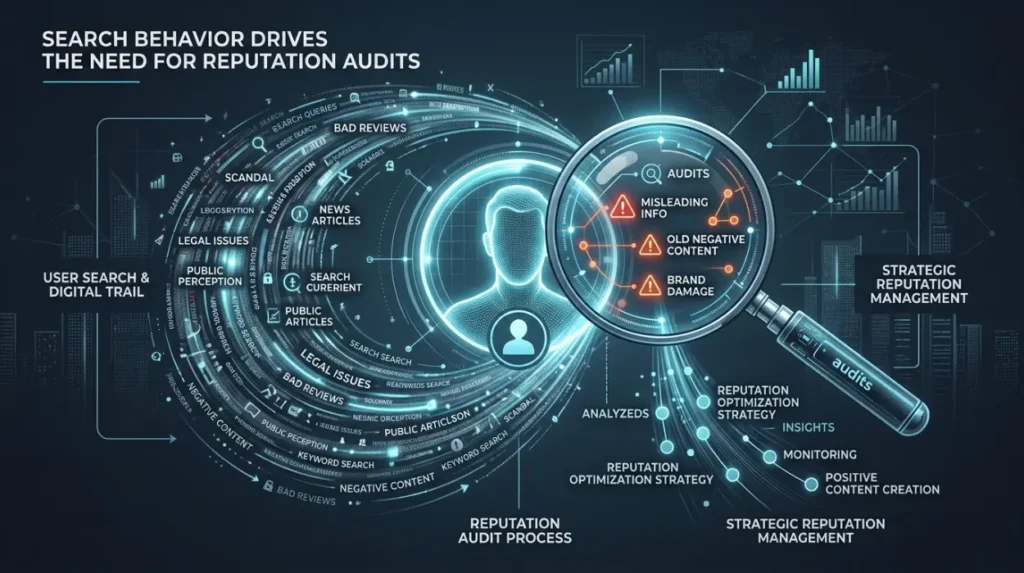
Candidates and employers increasingly rely upon search engines before engaging recruitment agencies. Search behaviour demonstrates that users compare multiple information sources before establishing trust, making digital reputation an important commercial asset.
A reputation audit evaluates exactly what users encounter throughout this decision process. It identifies inconsistencies between official business information and third-party references while measuring the authority of content appearing within branded search results.
Agencies that maintain consistent reputation signals experience greater stability because search engines recognise coherent entity relationships across trusted sources. Improved consistency contributes directly to stronger search perception influence and sustained visibility.
Decision-makers also benefit from understanding how competitors appear within search results. Comparative evaluation identifies opportunities where stronger authority signals, improved review consistency, or enhanced content quality create measurable competitive advantages.
How Does Reputation Management Reduce Long-Term Risk?
Effective reputation management reduces long-term risk because it continuously strengthens digital credibility rather than responding only after visibility declines. Search ecosystems evolve continuously as reviews accumulate, new content becomes indexed, and authority relationships change.
A structured audit identifies developing risks before they significantly influence search rankings or public perception. Early identification improves strategic planning while reducing the likelihood of unmanaged reputation issues becoming dominant within branded search results.
Recruitment agencies operate within highly competitive markets where trust directly influences candidate applications and client acquisition. Maintaining strong reputation signals therefore supports sustainable commercial performance alongside improved online visibility.
Which Measurable Benefits Does a Reputation Audit Deliver?
A recruitment agency reputation audit delivers measurable improvements because it identifies weaknesses affecting visibility before they develop into larger reputation issues. Every recommendation is based on evidence gathered from search ecosystems rather than assumptions. This structured approach improves decision-making by connecting reputation signals with practical outcomes. Stronger entity credibility contributes to improved search visibility, greater public confidence, and more stable digital performance. The audit also establishes a benchmark against which future reputation improvements can be measured.
The principal outcomes include:
- Identify visibility gaps that reduce branded search performance and limit SERP control.
- Strengthen reputation signals by correcting inconsistent business information across trusted directories.
- Improve review quality through analysis of sentiment trends and response consistency.
- Enhance entity credibility by identifying opportunities to strengthen authoritative content.
- Reduce reputation risk by detecting emerging issues before they dominate search results.
Each outcome contributes directly to a stronger and more reliable digital presence that supports long-term trust rather than short-term visibility gains.
Which Recruitment Agencies Benefit Most From a Reputation Audit?
A reputation audit provides value for agencies of every size because digital credibility influences recruitment decisions regardless of market position. Newly established agencies require strong entity recognition to compete effectively within search ecosystems, while established firms benefit from maintaining authority as digital information continues to evolve. Recruitment businesses operating across multiple locations also require consistent reputation signals to maintain visibility in different regional searches.
Agencies experiencing declining reviews, inconsistent listings, reduced branded search visibility, or increasing competition often gain the greatest insight from a structured audit. Organisations expanding into specialist recruitment sectors also benefit because search engines reassess topical authority as new content becomes available. Regular evaluation therefore supports sustainable growth by maintaining consistency across all digital assets.
Dive Deeper With Our Expert Guides:
How Much Does Reputation Management Cost for a Recruitment Agency?
How Do You Choose a Reputation Management Company for Recruitment Agencies?
Why Is a Free Reputation Audit an Effective Starting Point?
A free reputation audit provides an objective overview of current search visibility before strategic decisions are made. It identifies measurable issues affecting search perception without requiring immediate implementation of corrective actions. Decision-makers therefore gain clarity regarding existing strengths, weaknesses, and opportunities before investing in broader reputation initiatives.
The evaluation also establishes realistic priorities. Rather than attempting to improve every digital asset simultaneously, the audit identifies which reputation signals have the greatest influence on entity credibility and search ranking influence. This structured prioritisation reduces unnecessary expenditure while improving long-term efficiency. Within Clear My Name, a free audit is designed to provide transparent analysis that supports informed decision-making through measurable evidence rather than assumptions.
At this stage, organisations considering a professional reputation management service also benefit from understanding how existing reputation signals interact with search visibility. Reviewing broader research into recruitment agency review platforms provides additional context regarding where candidates and clients commonly evaluate agencies before making decisions. Likewise, analysing recruitment agency reputation monitoring demonstrates how continuous measurement complements the findings of a structured audit and supports long-term visibility management.
A recruitment agency reputation audit provides a comprehensive evaluation of the reputation signals influencing search visibility, public perception, and digital credibility. By examining reviews, search results, business listings, content authority, backlinks, and competitor positioning together, the audit creates an accurate picture of how search ecosystems interpret an organisation. This evidence-based process supports informed decisions that strengthen entity credibility, improve SERP control, and reduce long-term reputation risk.
Sustainable reputation management depends upon continuous evaluation rather than isolated corrective action. Search results evolve as new content is indexed, authority relationships change, and user behaviour influences reputation signals. A structured audit therefore provides the clarity required to maintain visibility, strengthen trust, and improve search perception over time.
Clear My Name delivers reputation management for recruiters through a transparent, evidence-driven methodology that prioritises measurable outcomes, process clarity, and long-term digital credibility. Every recommendation is based on search ecosystem analysis, ensuring organisations understand both the causes of reputation challenges and the practical actions that improve sustainable search visibility.
What does a recruitment agency reputation audit include?
A recruitment agency reputation audit evaluates search visibility, online reviews, business listings, branded search results, content quality, backlinks, and reputation signals. It identifies factors affecting entity credibility and public perception across search engines.
Why is a reputation audit important for recruitment agencies?
A reputation audit helps recruitment agencies understand how candidates and clients perceive them through search results. It highlights issues affecting search visibility, trust signals, and digital credibility before they influence recruitment decisions.
How often should a recruitment agency complete a reputation audit?
Recruitment agencies benefit from conducting a reputation audit regularly because search results, reviews, and indexed content change continuously. Routine audits help maintain consistent reputation signals and support long-term search visibility.
Can a reputation audit improve a recruitment agency’s online visibility?
A reputation audit does not directly change search rankings, but it identifies opportunities to strengthen search visibility and entity credibility. Addressing issues found during the audit supports better SERP control and a more consistent digital presence.
What is the difference between a reputation audit and ongoing reputation management?
A reputation audit provides a detailed assessment of a recruitment agency’s current online reputation, while ongoing reputation management focuses on maintaining and improving reputation signals over time. Together, they support stronger search perception and long-term digital trust.