

Facebook Page merges can scatter recommendations because reviews and recommendation signals do not always transfer into one unified search or platform record. Reputation management is the process of analysing and maintaining how an entity is represented through information, reviews, content and search results. Online reputation refers to the collection of digital signals that shape how search systems and users interpret an entity.
Why can a Facebook Page merge scatter recommendations?
A Facebook Page merge can scatter recommendations when platform records, review references and historical engagement data remain associated with different page identities. A merged page represents an attempt to consolidate two Facebook presences into a single entity, but consolidation does not automatically create one perfectly unified reputation record. Recommendations exist as platform-generated reputation signals connected to page identity, user activity and historical content. When those relationships are reorganised, some recommendations can remain attached to legacy references or appear differently within the resulting page structure. This creates a distinction between the visible page and the underlying information relationships used to interpret it. From a reputation perspective, the issue is therefore an information-structure problem rather than simply a missing review count.
How are Facebook recommendations connected to page identity?
Facebook recommendations are connected to page identity through platform records that associate user-generated content with a specific business or organisation page. Page identity refers to the collection of attributes that distinguish one entity record from another within a digital platform. These attributes include the page name, category, location, profile information, historical activity and associated user interactions. A merge changes the relationship between two page identities by establishing one page as the surviving representation. Historical recommendations therefore depend on how the platform maps their original page association to the surviving entity. Reputation signals remain dependent on these underlying relationships even when users see a single public-facing page.
What happens to recommendation signals during a Facebook Page merge?
Recommendation signals can become fragmented when the platform restructures the relationship between the source page and the destination page. A recommendation is a reputation signal because it contributes user-generated evidence about an entity’s perceived quality and credibility. During a merge, the platform processes information associated with two separate page records and determines how that information relates to the remaining page. The resulting presentation does not necessarily reproduce every historical signal in an identical form. Differences in page identity, content association and historical activity influence how recommendations are represented. This explains why a page can retain a visible recommendation history while still showing changes in the distribution or accessibility of older recommendations.
Why do historical recommendations have different visibility after a merge?
Historical recommendations can have different visibility because content indexing and platform-level organisation operate through relationships between records rather than through a simple numerical transfer. Visibility refers to how easily a reputation signal can be accessed, displayed or interpreted within a search or platform environment. A recommendation associated with an older page record has a different information relationship from one created directly on the surviving page. When those records are consolidated, the platform’s presentation layer determines which information remains directly connected to the current identity. Search systems also evaluate accessible content according to relevance, authority, freshness and entity relationships. As a result, the apparent visibility of recommendations can change without the underlying user-generated information necessarily being deleted.
How does page identity affect reputation signals?
Page identity affects reputation signals because search and social platforms use entity relationships to distinguish one organisation from another. An entity is a recognisable subject represented through connected information across digital systems. Facebook Page information forms part of that representation by linking names, categories, locations, recommendations and user interactions to a particular page record. When two records become one, the platform has to establish which attributes belong to the continuing entity. This process affects the context in which recommendation signals are interpreted. Strong entity consistency therefore provides a clearer information structure for understanding whether historical recommendations relate to the same organisation.
Can a Facebook Page merge change how users interpret recommendations?
A Facebook Page merge can change user interpretation because recommendation visibility contributes to the perceived completeness and consistency of an entity’s reputation profile. Users interpret recommendations alongside page information, activity, photographs, comments and other available content. A visible concentration of recommendations on one page creates a different perception from a fragmented history distributed across legacy records. Search perception refers to the way available digital information influences an individual’s understanding of an entity when reviewing search results or platform profiles. Changes in information presentation therefore affect perception even when the underlying recommendation content remains authentic. The distinction between information availability and information interpretation is central to understanding reputation after a page merge.
How do Facebook reviews differ from other reputation signals?
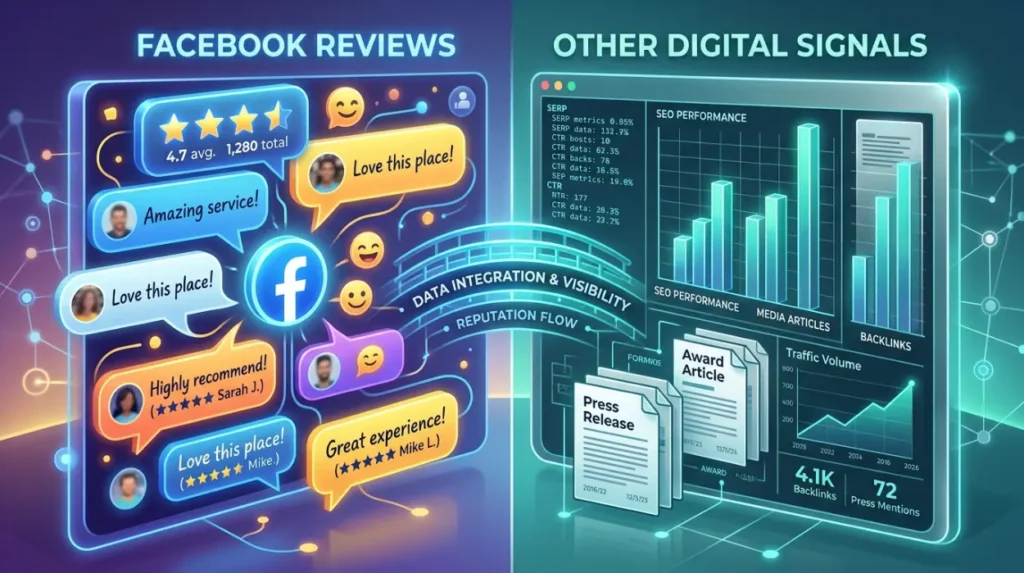
Facebook recommendations differ from other reputation signals because they originate from direct user interactions within a specific social platform and page environment. A recommendation contains both evaluative content and an association with the page where the user submitted it. Other reputation signals include press coverage, directory information, professional profiles, social posts, website content and search snippets. Search engines evaluate these sources through different combinations of relevance, authority, context and entity association. A Facebook recommendation therefore forms one component of a broader digital footprint rather than representing the complete reputation of an entity. Understanding this distinction prevents platform-specific review changes from being interpreted as a complete change in overall online reputation.
How does sentiment influence recommendation interpretation?
Sentiment influences recommendation interpretation by providing a qualitative signal about how users describe or evaluate an entity. Sentiment analysis refers to the classification and interpretation of language associated with positive, negative or neutral opinions. Recommendation content contains semantic information that can contribute to the broader understanding of an entity’s reputation. Search systems and platform algorithms process language alongside contextual information rather than treating every positive or negative expression as an isolated ranking factor. The meaning of a recommendation therefore depends on its wording, subject, entity association and surrounding information. A fragmented recommendation history can make sentiment distribution harder to interpret because the available content is not always presented as one continuous dataset.
How does content indexing affect scattered Facebook recommendations?
Content indexing affects scattered recommendations by determining which publicly accessible information enters a search engine’s searchable representation. Indexing is the process through which search systems discover, process and store information for potential retrieval in search results. Facebook content has platform-specific access and indexing characteristics, meaning that not every recommendation or page interaction receives identical search visibility. A page merge can alter the structure through which historical information is discovered and associated with an entity. Search engines then evaluate the available content based on their own crawling, indexing and ranking processes. Consequently, a change in Facebook’s page structure can influence external search visibility without creating a direct one-to-one ranking change.
What role does entity consistency play after a Page merge?
Entity consistency provides the structural connection between historical reputation information and the current representation of an organisation. Entity consistency refers to the alignment of identifying information across digital properties, including names, locations, categories and authoritative profiles. When these attributes remain consistent, search systems have clearer signals for determining that information belongs to the same entity. Inconsistent information introduces competing interpretations about whether separate records represent one organisation or different entities. This distinction becomes more significant when historical recommendations are connected to legacy page identities. Entity consistency therefore supports accurate interpretation of reputation signals across social platforms and search ecosystems.
Dive Deeper With Our Expert Guides:
How Photos and Tags in Facebook Reviews Sway Buyers
Why Review Velocity Matters More Than Total Review Count
How can scattered recommendations influence search perception?
Scattered recommendations can influence search perception when users encounter inconsistent or incomplete representations of an entity across digital surfaces. Search perception is the cumulative interpretation formed from the information visible through search engines and other online platforms. A Facebook recommendation is one signal within that broader information environment, while search results also contain websites, directories, social profiles, news content and other references. If these sources present conflicting information, users receive a less coherent representation of the entity. Search engines similarly evaluate relationships between entities and their associated content when determining relevance and ranking. The effect of scattered recommendations therefore relates to information consistency, accessibility and context rather than the numerical review total alone.
How can recommendation consolidation be understood as an information problem?
Recommendation consolidation is fundamentally an information problem because the central issue concerns how separate records, content relationships and reputation signals become associated with one entity. Consolidating Recommendations After a Facebook Page Merge involves understanding the distinction between the visible page, historical page records and the relationships connecting user-generated content to each identity. A platform’s public interface represents only one layer of this structure. Underlying records determine how information is associated, displayed and accessed. Search engines then introduce another layer by independently crawling, indexing and evaluating accessible content. Analysing these layers separately provides a clearer explanation of why recommendation histories can appear fragmented after a merge.
What does a scattered recommendation history indicate about online reputation?
A scattered recommendation history indicates that online reputation is distributed across multiple information systems rather than contained within one review total. Digital reputation consists of interconnected signals created through social platforms, websites, search results, directories, publications and user-generated content. Each source has its own structure, authority and relationship to the underlying entity. A Facebook Page merge can therefore change one component of the digital footprint without determining the complete reputation profile. Accurate analysis requires examining how information is connected, indexed and interpreted across the wider search ecosystem. This approach separates platform-level changes from broader changes in entity credibility and search perception.
Why is understanding recommendation structure important for SERP evaluation?
Understanding recommendation structure is important because SERP evaluation depends on the broader context surrounding an entity rather than on a single platform signal. SERP evaluation refers to the assessment of search engine results pages in terms of ranking position, relevance, authority, sentiment and entity representation. Facebook recommendations can contribute contextual information when their content is accessible and associated clearly with an identifiable entity. Their influence therefore depends on their relationship with other authoritative information sources. A fragmented recommendation history provides one example of how digital information can become distributed across platform records. Examining those relationships produces a more accurate understanding of how reputation signals contribute to online visibility.
What is the broader relationship between Facebook recommendations and digital reputation?
Facebook recommendations form one layer of a broader digital reputation system in which user-generated content interacts with entity information, search visibility and trust signals. Digital reputation refers to the accumulated representation of an entity across connected online information sources. A page merge changes the organisational structure of one platform’s information, but it does not independently determine how search engines interpret the entire entity. Search systems consider content relevance, authority, consistency, accessibility and contextual relationships when processing information. Users similarly evaluate reputation through the combined evidence available across multiple digital surfaces. Understanding Facebook recommendation fragmentation therefore requires analysing the complete information ecosystem rather than treating the recommendation count as an isolated measure.
Facebook Page merges can scatter recommendations because separate page identities contain distinct information relationships that require restructuring during consolidation. Reputation management is the analysis of how those signals are created, connected, interpreted and represented across digital ecosystems. Recommendation visibility depends on page identity, content relationships, indexing, sentiment and entity consistency. Search perception extends beyond Facebook because search engines evaluate the wider digital footprint surrounding an entity. Understanding these mechanisms provides a clearer framework for analysing changes in recommendation visibility without treating a platform-level merge as a complete transformation of online reputation.
Why do Facebook Page merges scatter recommendations?
Facebook Page merges can scatter recommendations when reviews and historical activity remain connected to different page records. The resulting page structure can affect how recommendation signals are displayed and associated with the current entity.
Do Facebook recommendations transfer after a Page merge?
Recommendations can be affected by how Facebook consolidates the source and destination page records. Some historical recommendation information can appear differently after the merge because page identity and content relationships have changed.
Can a Facebook Page merge affect online reputation?
Yes, a Page merge can affect how an entity’s existing reputation signals are presented and interpreted. Changes in recommendation visibility can influence the perceived consistency of a Facebook presence without necessarily changing the underlying feedback.
How do Facebook recommendations influence search reputation?
Facebook recommendations form part of an entity’s broader digital reputation by providing user-generated feedback and sentiment signals. Their influence on search perception depends on accessibility, entity association, content relevance and how search engines process the information.
Can Clear My Name help with Facebook recommendation issues after a Page merge?
Clear My Name provides context around Facebook Reviews as part of broader reputation management considerations. Understanding page identity, recommendation structure and content visibility helps determine how fragmented review signals relate to an entity’s online reputation.